



Experimental Study on Secondary-hydration Self-healing Performance of Microcracks in Wellbore Cement Sheaths
-
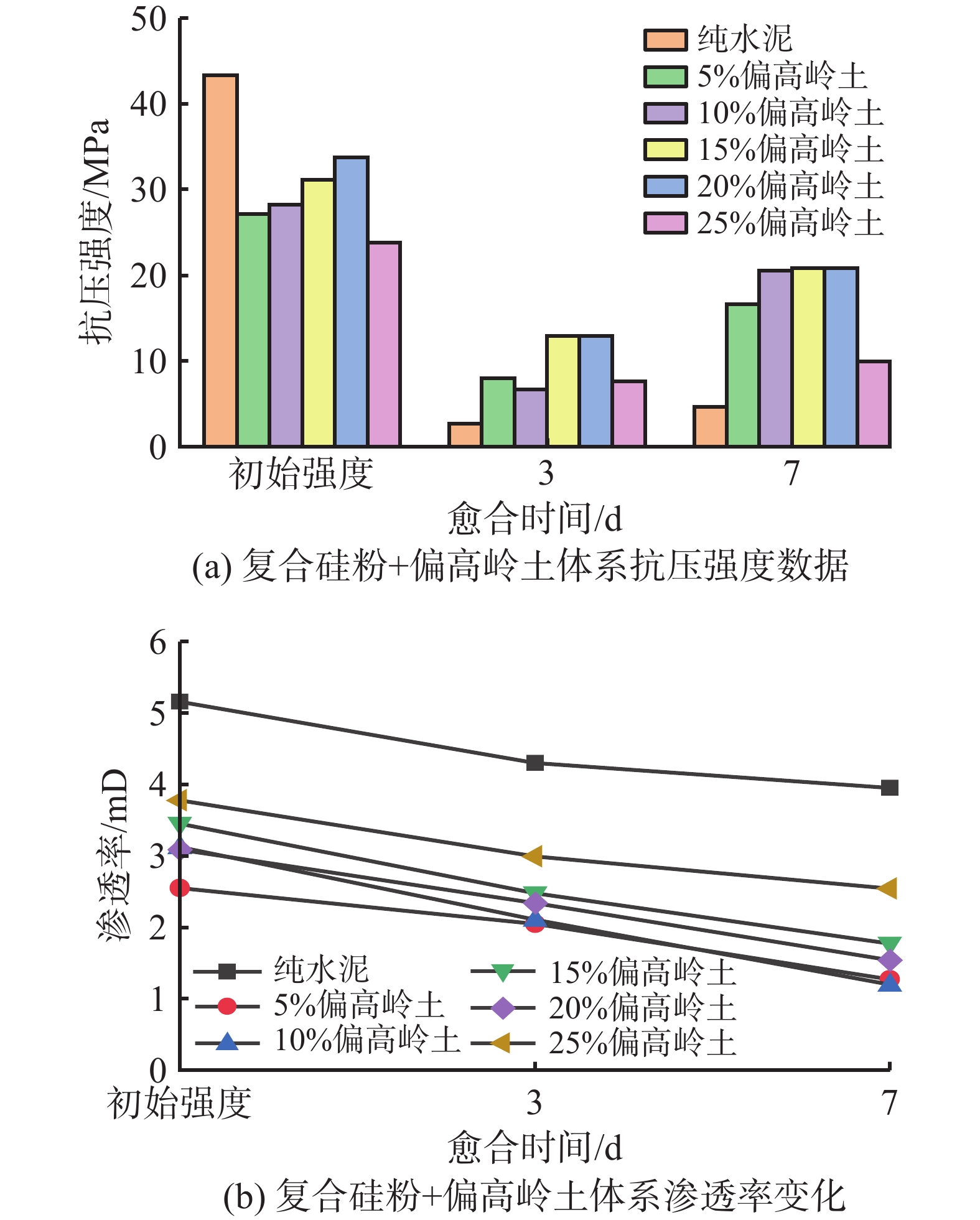
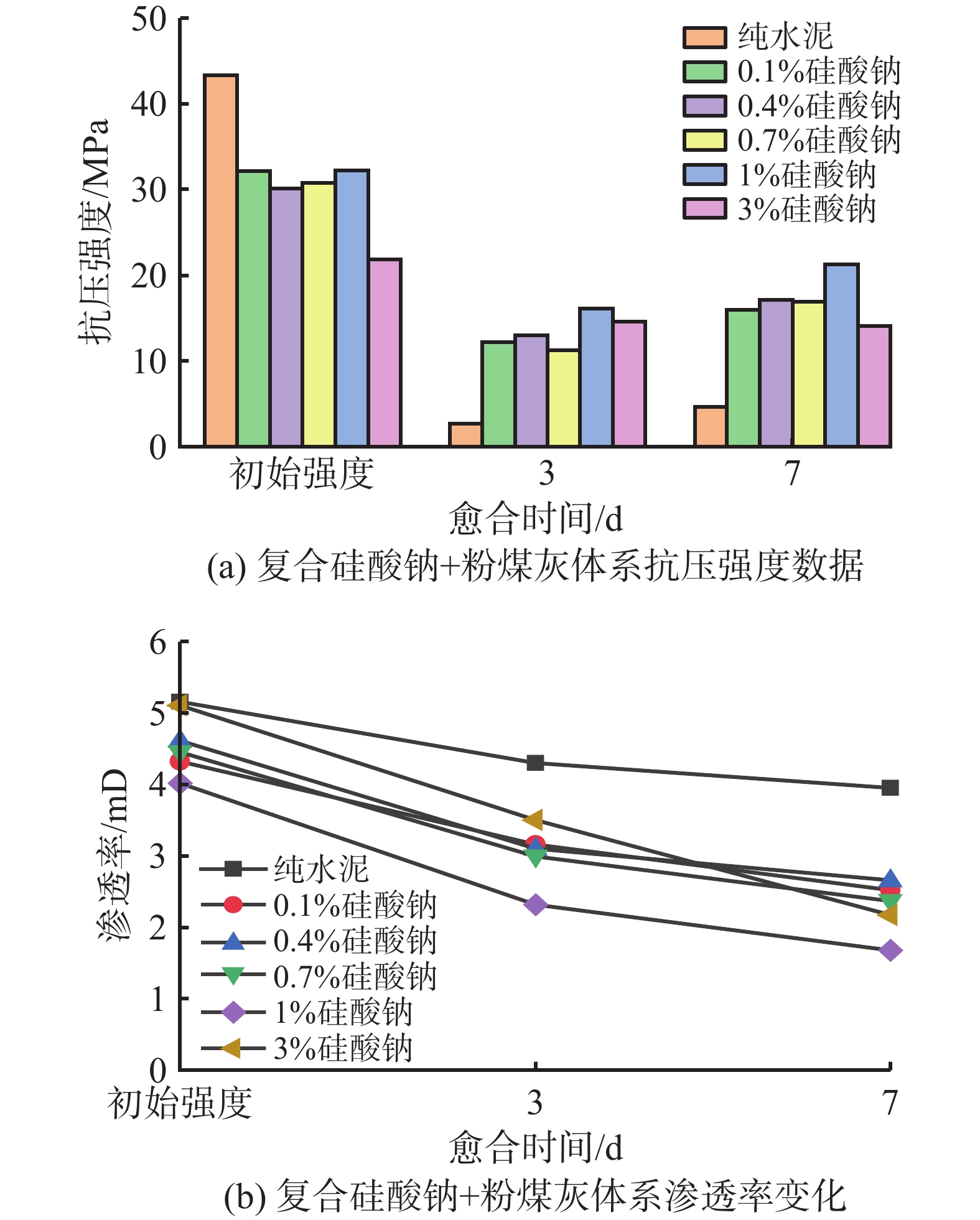
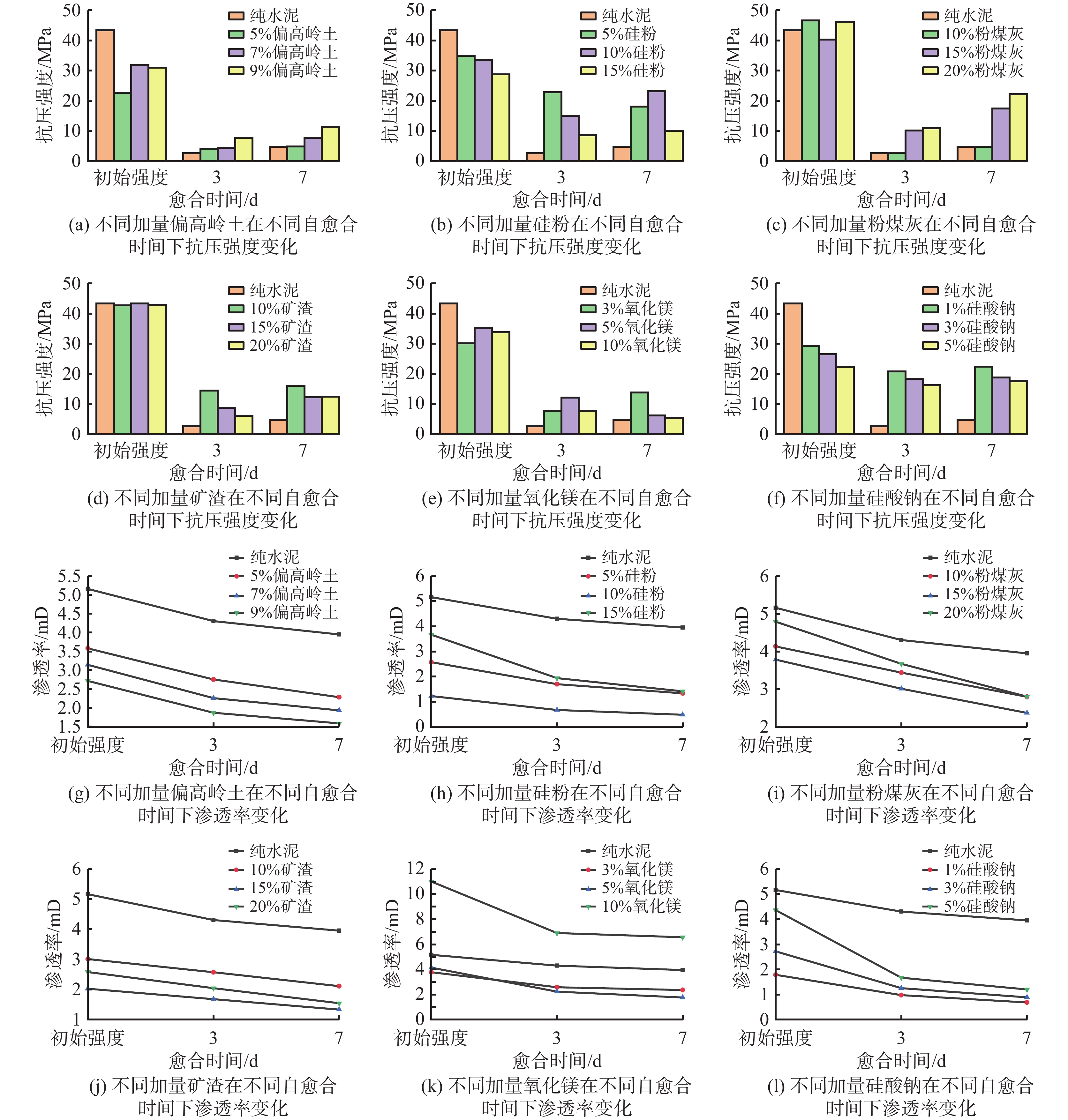
摘要: 固井水泥环密封完整性直接关系到油气井服役安全与寿命,复杂工况易引发微裂缝,早期未修复将导致腐蚀性流体侵入、套管劣化等风险,现有研究忽视短期修复与流变性能。以G级高抗油井水泥为基体,选取6种浅活性材料为二次水化型自愈合剂,经单掺筛选与复合体系构建,从流变性能、抗压强度及渗透率3个方面探究短期3 d、7 d的自愈合效果。结果表明,单掺体系中10%硅粉与1%硅酸钠修复性能最优,养护7 d强度恢复率分别达70.6%和78.5%;复合体系呈显著协同作用,20%粉煤灰+1%硅酸钠综合性能最佳,养护7 d强度恢复率为72.37%、渗透率降低率为60.69%,成本更低且施工稳定。研发的自愈合剂破解了传统材料“反应慢、成本高”的瓶颈,为油气井早期井筒修复提供支撑,对保障井筒完整性、降本增效具有重要工程意义。Abstract: The sealing integrity of cement sheaths in well cementing is directly related to the operational safety and service life of oil and gas wells. However, complex service conditions can readily induce microcracks, which, if not repaired at an early stage, may lead to corrosive fluid invasion, casing deterioration, and other risks. Existing studies have paid insufficient attention to short-term repair performance and rheological properties. In this paper, Class G high-sulfate-resistant oil well cement was used as the base material, and six latent reactive materials were selected as secondary-hydration self-healing agents. Through single-additive screening and the construction of composite systems, the short-term self-healing effects after 3 and 7 days of curing were investigated in terms of rheological properties, compressive strength, and permeability. The results show that among the single-additive systems, 10% silica fume and 1% sodium silicate exhibit the best repair performance, with strength recovery rates reaching 70.6% and 78.5%, respectively, after 7 d of curing. The composite systems exhibit a significant synergistic effect. Among them, the system containing 20% fly ash and 1% sodium silicate exhibits the best overall performance, with a strength recovery rate of 72.37% and a permeability reduction rate of 60.69% after 7 d of curing, while also offering lower cost and good field applicability. The developed self-healing agent overcomes the limitations of traditional materials, such as slow reaction and high cost, and provides technical support for early-stage wellbore repair in oil and gas wells. It is of great engineering significance for ensuring wellbore integrity, reducing costs, and improving efficiency.
-
Key words:
- Well cement /
- Microcrack /
- Crystalline-precipitation self-healing agent
-
表 1 单一浅活性材料流变性能表
浅活性材料 t稠化/min
(80 ℃)φ600/φ300/φ200/
φ100/φ6/φ3PV/
mPa·sYP/
Pa纯水泥 183 105/54/35/17/2/1 51 1.5 5%偏高岭土 214 137/68/45/22/1/0.5 69 0.5 7%偏高岭土 217 124/62/37/20/2/1 62 0 9%偏高岭土 216 110/58/39/19/1/0.5 52 3.0 5%硅粉 215 172/96/65/32/1.5/0.5 76 10.0 10%硅粉 195 249/134/92/47/2/1 115 9.5 15%硅粉 203 224/118/80/42/3/1 106 6.0 10%粉煤灰 205 176/91/60/29/2/1 85 3.0 15%粉煤灰 213 179/94/61/31/2/1 85 4.5 20%粉煤灰 220 181/96/63/32/2/1 85 5.5 10%矿渣 172 131/73/55/31/3/1 58 7.7 15%矿渣 170 136/77/59/40/38/27 59 9.2 20%矿渣 163 143/75/52/29/5/1 68 3.6 3%氧化镁 162/85/56/27/1.5/0.5 77 4.1 5%氧化镁 175/89/61/29/2/1 86 1.5 10%氧化镁 191/99/67/33/3/1 92 3.6 1%硅酸钠 26 140/69/45/22/1/0.5 71 1.0 3%硅酸钠 169/107/75/60/45/32 62 23.0 5%硅酸钠 154/79/55/32/7/2 75 2.0  下载: 导出CSV
表 2 复合硅粉+偏高岭土体系流变性能
偏高
岭土/%硅粉/
%t稠化/min
(80 ℃)φ600/φ300/φ200/
φ100/φ6/φ3PV/
mPa·sYP/
Pa0 0 183 105/54/35/17/2/1 51 1.5 5 10 186 178/93/67/31/2/0.5 85 4.1 10 10 175 192/98/67/34/2/1 94 2.0 15 10 172 210/107/72/38/3/1 103 2.0 20 10 115 220/118/84/45/5/3 102 8.2 25 10 90 224/123/90/46/4/3 101 11.2
下载: 导出CSV
表 3 复合硅酸钠+粉煤灰体系流变性能表
硅酸
钠/%粉煤
灰/%t稠化/min
(80 ℃)φ600/φ300/φ200/
φ100/φ6/φ3PV/
mPa·sYP/
Pa0 0 183 105/54/35/17/2/1 51 1.5 0.1 20 195 175/95/71/44/5/3 80 7.7 0.4 20 177 169/97/72/46/22/6 72 12.8 0.7 20 165 217/106/69/45/6/3 111 2.6 1.0 20 147 235/120/82/41/3/1 115 2.6 3.0 20 295/185/152/121/50/11 110 38.3
下载: 导出CSV
-
[1] 柳华杰. 固井水泥石微裂缝遇水自封堵技术[D]. 青岛: 中国石油大学(华东), 2016.Liu Huajie. Self-sealing technology for micro-fractures in cement stone during well cementing when exposed to water[D]. Qingdao: China University of Petroleum, 2016. [2] 王静. 水泥自修复技术在固井中应用研究进展[J]. 石油化工应用, 2024, 43(10): 1-3,22.Wang Jing. Research progress on the application of cement self-healing technology in cementing[J]. Petro-chemical Industry Application, 2024, 43(10): 1-3,22. [3] 刘萌. 固井水泥浆用自修复材料的探索研究[D]. 成都: 西南石油大学, 2015.Liu Meng. Exploratory research on self-healing materials for cement slurry in well cementing[D]. Chengdu: Southwest Petroleum University, 2015. [4] 戢现贵, 余纲, 王海涛, 等. 超深高压储气库固井水泥浆技术[J]. 钻井液与完井液, 2026, 43(2): 223-233.Ji Xiangui, Yu Gang, Wang Haitao, et al. Cementing slurry technology for ultra-deep and high-pressure gas storage[J]. Drilling Fluid & Completion Fluid, 2026, 43(2): 223-233. [5] 徐兴居. 水泥基材料裂缝自愈合研究进展[J]. 工程质量, 2026, 44(3): 73-77.Xu Xingju. Research progress on Self-Healing of cracks in cement-based materials[J]. Construction Quality, 2026, 44(3): 73-77. [6] 李俊. CO2环境中脲醛树脂对油井水泥石微裂缝自修复性能影响研究[D]. 成都: 西南石油大学, 2024.Li Jun. Study on the influence of urea-formaldehyde resin on the self-healing performance of micro-cracks in oil well cement stone in CO2 environment[D]. Chengdu: Southwest Petroleum University, 2024. [7] 王凯. 固井水泥环微裂缝封堵剂研究[D]. 青岛: 中国石油大学(华东), 2020.Wang Kai. Research on micro-fracture sealing agent for cement sheath in well cementing[D]. Qingdao: China University of Petroleum, 2020. [8] 李文哲, 付志, 张震, 等. 用于诱导微裂缝封堵的油基凝胶体系[J]. 钻井液与完井液, 2023, 40(4): 446-452,461.Li Wenzhe, Fu Zhi, Zhang Zhen, et al. Study and application of an oil-based gel fluid for sealing induced micro-fractures[J]. Drilling Fluid & Completion Fluid, 2023, 40(4): 446-452,461. [9] 龚鹏. CCUS井中二氧化碳诱导结晶愈合水泥石裂缝的机理研究[D]. 成都: 西南石油大学, 2022.Gong Peng. Mechanism study on carbon dioxide-induced crystallization healing of cement stone fractures in CCUS wells[D]. Chengdu: Southwest Petroleum University, 2022. [10] 赵峰. CO2诱导碳酸盐沉积过程及油井水泥石裂纹自愈合机理研究[D]. 成都: 西南石油大学, 2020.Zhao Feng. Study on CO2-induced carbonate deposition process and self-healing mechanism of oil well cement stone cracks[D]. Chengdu: Southwest Petroleum University, 2020. [11] 方成. 基于陶粒内置碳源自愈合水泥基材料的实验研究[D]. 深圳: 深圳大学, 2018.Fang Cheng. Experimental research on self-healing cement-based materials with carbon sources embedded in ceramsite[D]. Shenzhen: Shenzhen University, 2018. [12] 张涛. 聚碳酸酯基自修复材料的合成[D]. 西安: 西安石油大学, 2024.Zhang Tao. Synthesis of polycarbonate-based self-healing materials[D]. Xi'an: Xi'an Shiyou University, 2024. [13] 张超, 李许, 曲顺义, 等. 工程水泥基复合材料: 自愈合能力的综述与探索[J]. 建筑施工,2024,46(11): 1754-1758.Zhang Chao, Li Xu, Qu Shunyi, et al. Engineering cementitious composite materials: review and exploration of self-healing ability[J]. Building Construction, 2024, 46(11): 1754-1758. [14] Kim-Séang Lauch, Desmettre C, Charron J . Self-healing of aged concrete containing crystalline admixture and expansive agent under repeated loading[J]. Journal of Materials in Civil Engineering, 2023, 35(2): 4022396-4022407. [15] Tamimi Y, Al-Kheetan MJ, Al-Mansoori T, et al. A self-healing approach to cement-based materials with crystalline admixtures in normal and accelerated environmental conditions[J]. MATEC Web of Conferences, 2023, 367:130297. [16] 夏小龙. 油井水泥石微裂纹遇水自愈合剂的研究[D]. 成都: 西南石油大学, 2022.Xia Xiaolong. Research on self-healing agent for microcracks in oil well cement stone upon contact with water[D]. Chengdu: Southwest Petroleum University, 2022. [17] 张晨晨. 基于离子络合剂的水泥基材料自愈合性能研究[D]. 哈尔滨: 哈尔滨工业大学, 2022.Zhang Chenchen. Research on the self-healing properties of cement-based materials based on ion complexing agents[D]. Harbin: Harbin Institute of Technology, 2022. [18] 余春阳. 油井水泥石微裂缝遇水自修复材料研究[D]. 成都: 西南石油大学, 2020.Yu Chunyang. Research on self-healing materials for micro-cracks in oil well cement stone upon contact with water[D]. Chengdu: Southwest Petroleum University, 2020. [19] Hermawan H, Beltran G S, Wiktor V, et al. Effect of healing agents on the rheological properties of cement paste and compatibility with superplasticizer[C]//8th International Conference on Concrete Repair, Durability & Technology. Valencia, Spain: MATEC, 2022: 05008. [20] 陈帅帅, 李敏, 袁连旺, 等. 水灰比对水泥基材料裂缝自愈合机制的影响[J]. 济南大学学报(自然科学版), 2021, 35(4): 387-394.Chen Shuaishuai, Li Min, Yuan Lianwang, et al. Effect of water to cement ratio on crack self-healing mechanism of cement matrix materials[J]. Journal of University of Jinan (Science and Technology), 2021, 35(4): 387-394. [21] 李阳. 偏高岭土提高水泥性能及水化机理研究[D]. 武汉: 武汉理工大学, 2017.Li Yang. Research on improving the performance of cement and hydration mechanism of metakaolin[D]. Wuhan: Wuhan University of Technology, 2017. [22] 姜广, 戎志丹, 孙伟. 偏高岭土对高性能水泥砂浆性能的影响[J]. 东南大学学报(自然科学版), 2015, 45(1): 121-125.Jiang Guang, Rong Zhidan, Sun Wei. Effects of metakaolin on properties of high performance mortar[J]. Journal of Southeast University(Natural Science Edition), 2015, 45(1): 121-125. [23] 殷慧, 柳华杰, 季成元, 等. 偏高岭土活性影响因素及其碱激发反应研究进展[J]. 钻井液与完井液, 2024, 41(4): 419-426.Yin Hui, Liu Huajie, Ji Chengyuan, et al. Progress in studying affecting factors and alkaline-activated reaction of activity of metakaolin[J]. Drilling Fluid & Completion Fluid, 2024, 41(4): 419-426. [24] 任成强, 于杰. 硅灰-矿粉改性透水再生混凝土力学性能及耐磨性影响研究[J]. 水泥工程, 2025(1): 91-96. doi: 10.13697/j.cnki.32-1449/tu.2025.01.022Ren Chengqiang, Yu Jie. Study on the mechanical properties and wear resistance of silica fume mineral powder modified permeable recy-cled concrete[J]. Cement Engineering, 2025(1): 91-96. doi: 10.13697/j.cnki.32-1449/tu.2025.01.022 [25] 饶志华, 邓成辉, 马倩芸, 等. CCUS井工况下不同引晶材料对水泥石裂缝自愈合过程的影响[J]. 钻井液与完井液, 2023, 40(4): 495-501. doi: 10.12358/j.issn.1001-5620.2023.04.012Rao Zhihua, Deng Chenghui, Ma Qianyun, et al. Comparative study on effects of different crystallographic materials on self-healing of fractures in set cement under CCUS well work conditions[J]. Drilling Fluid & Completion Fluid, 2023, 40(4): 495-501. doi: 10.12358/j.issn.1001-5620.2023.04.012 [26] 张军学. 水泥基材料的自愈合特性研究[D]. 武汉: 武汉理工大学, 2012.Zhang Junxue. Investigation on the self-healing of cementitious materials[D]. Wuhan: Wuhan University of Technology, 2012. [27] 李继芸. 纳米复合水泥基渗透结晶型防水材料自愈合性能研究[D]. 成都: 西南交通大学, 2023.Li Jiyun. Study on self-healing properties of nanocomposite cementitious capillary crystalline water-proofing materials[D]. Chengdu: Southwest Jiaotong University, 2023. [28] 刘亦洁. 氧化镁/丙烯酸镁对水泥基材料自愈合性能的影响[D]. 焦作: 河南理工大学, 2023.Liu Yijie. Effect of magnesium oxide/magnesium acrylate on self healing properties of cement based materials[D]. Jiaozuo: Henan Polytechnic University, 2023. [29] 冯竟竟, 张鹏, 陈伟, 等. 氧化镁膨胀剂对混凝土早期裂缝自愈合性能的影响[J]. 建筑材料学报, 2018, 21(4): 656-662.Feng Jingjing, Zhang Peng, Chen Wei, et al. Self-healing Behavior of Early Concrete Cracks Incorporating Magnesium Oxide Expansive Agent[J]. Journal of building materials, 2018, 21(4): 656-662. [30] 李博闻, 成云海, 李伟利, 等. 碱激发铜渣-粉煤灰复合胶凝材料的力学性能及水化机理研究[J]. 煤炭与化工, 2024, 47(10): 141-148.Li Bowen, Cheng Yunhai, Li Weili, et al. Study on the mechanical properties and hydration mechanism of alkali activated copper slag fly ash composite cementitious material[J]. Coal and Chemical Industry, 2024, 47(10): 141-148. [31] 步玉环, 于利国, 王春雨, 等. 水泥石自愈合性能评价方法[J]. 实验室研究与探索, 2015, 34(7): 17-21,138.Bu Yuhuan, Yu Liguo, Wang Chunyu, et al. Evaluation method of the self-healing property of cement[J]. Research and Exploration in Laboratory, 2015, 34(7): 17-21,138. [32] 龚雨. 自愈合水泥浆体系优化研究[D]. 成都: 西南石油大学, 2015.GONG Yu. Study on optimization of self-healing cement slurry system [D]. Chengdu: Southwest Petroleum University, 2015. [33] 郝震. 固井自愈合水泥浆体系的研究与应用[D]. 青岛: 中国石油大学(华东), 2021.Hao Zhen. Research and application of self-healing slurry in well-cementing[D]. Qingdao: China University Of Petroleum, 2021. [34] 杜静, 曾雪玲, 张洋勇, 等. 固井自愈合水泥技术的研究现状与发展趋势[J]. 石油化工应用, 2023, 42(1): 12-17.Du Jing, Zeng Xueling, Zhang Yangyong, et al. Research status and development trend of the cementing self-healing cement technology[J]. Petrochemical Industry Application, 2023, 42(1): 12-17. [35] 郑友志, 佘朝毅, 付洪琼, 等. 一种溶黏型仿生自愈合水泥浆体系[J]. 天然气工业, 2023, 43(5): 63-70. doi: 10.3787/j.issn.1000-0976.2023.05.007Zheng Youzhi, She Chaoyi, Fu Hongqiong, et al. A viscosity-soluble type biomimetic self-healing cement slurry system[J]. Natural Gas Industry, 2023, 43(5): 63-70. doi: 10.3787/j.issn.1000-0976.2023.05.007 -

 点击查看大图
图(4) / 表(3)
计量
- 文章访问数: 22
- HTML全文浏览量: 8
- PDF下载量: 2
- 被引次数: 0
