



Preparation and Performance Evaluation of Novel Organoclay for Oil-based Drilling Fluids
-
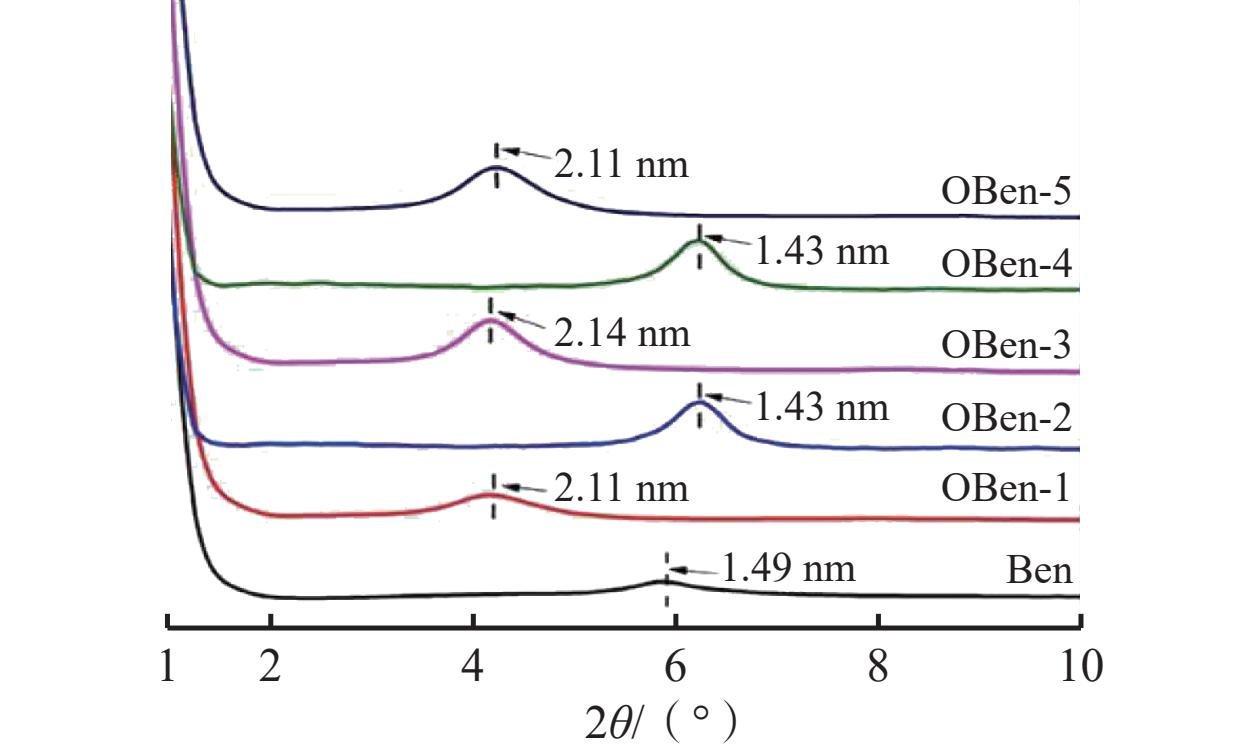
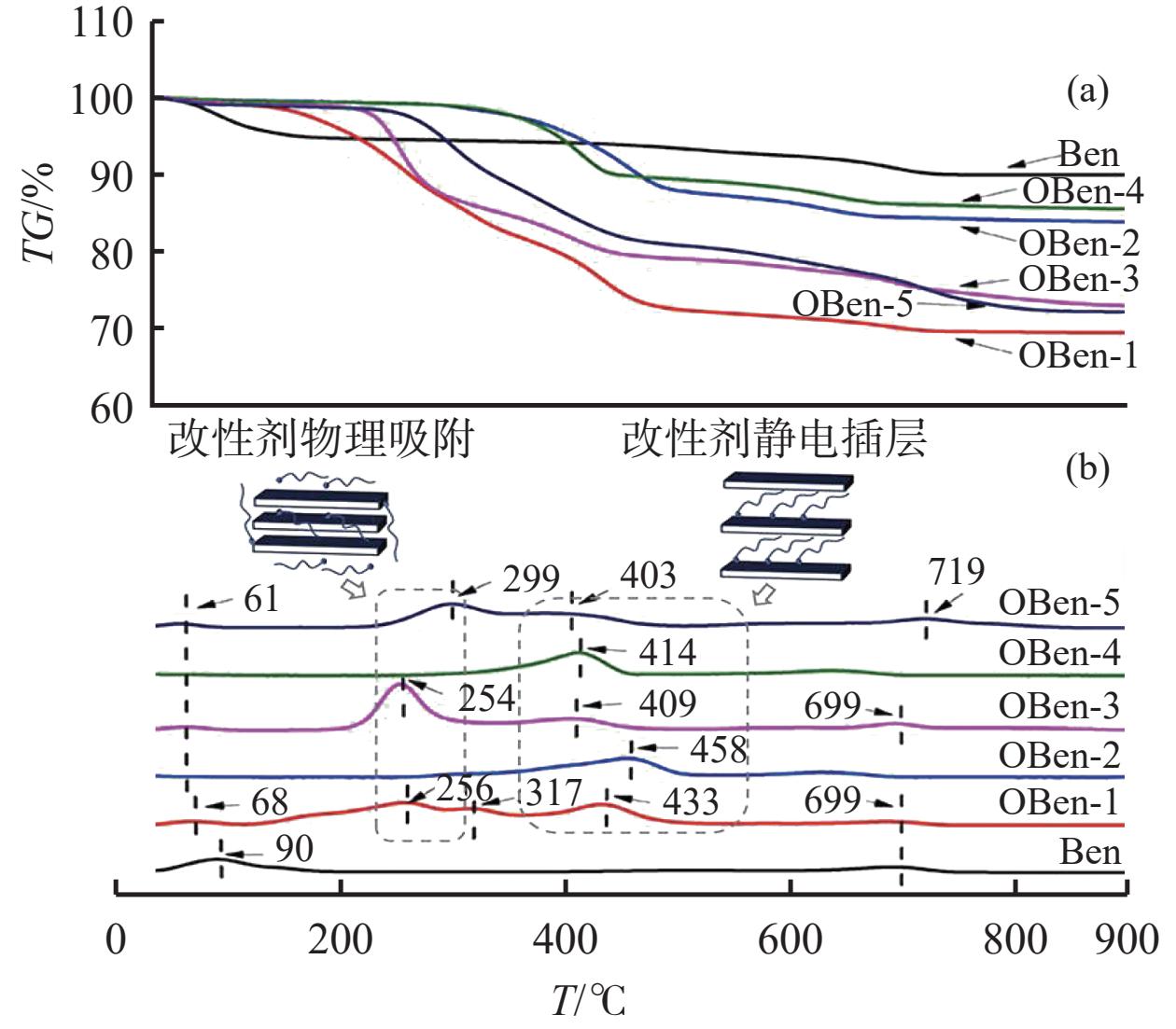
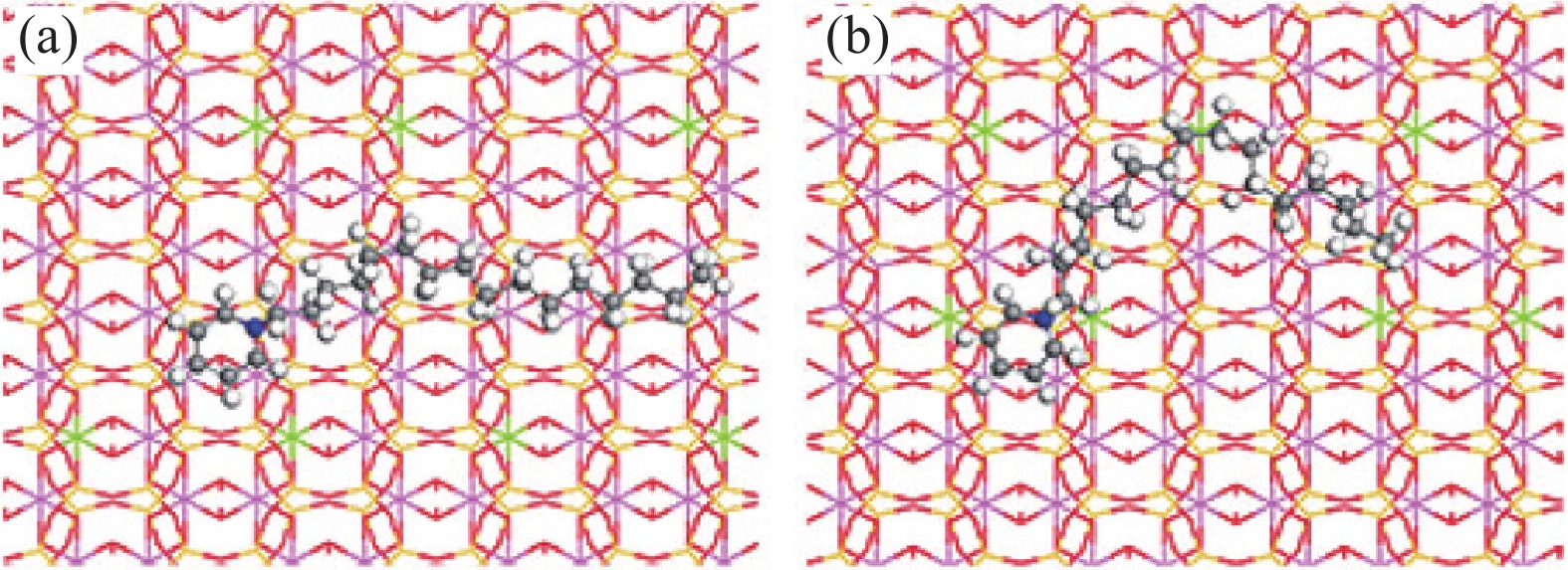
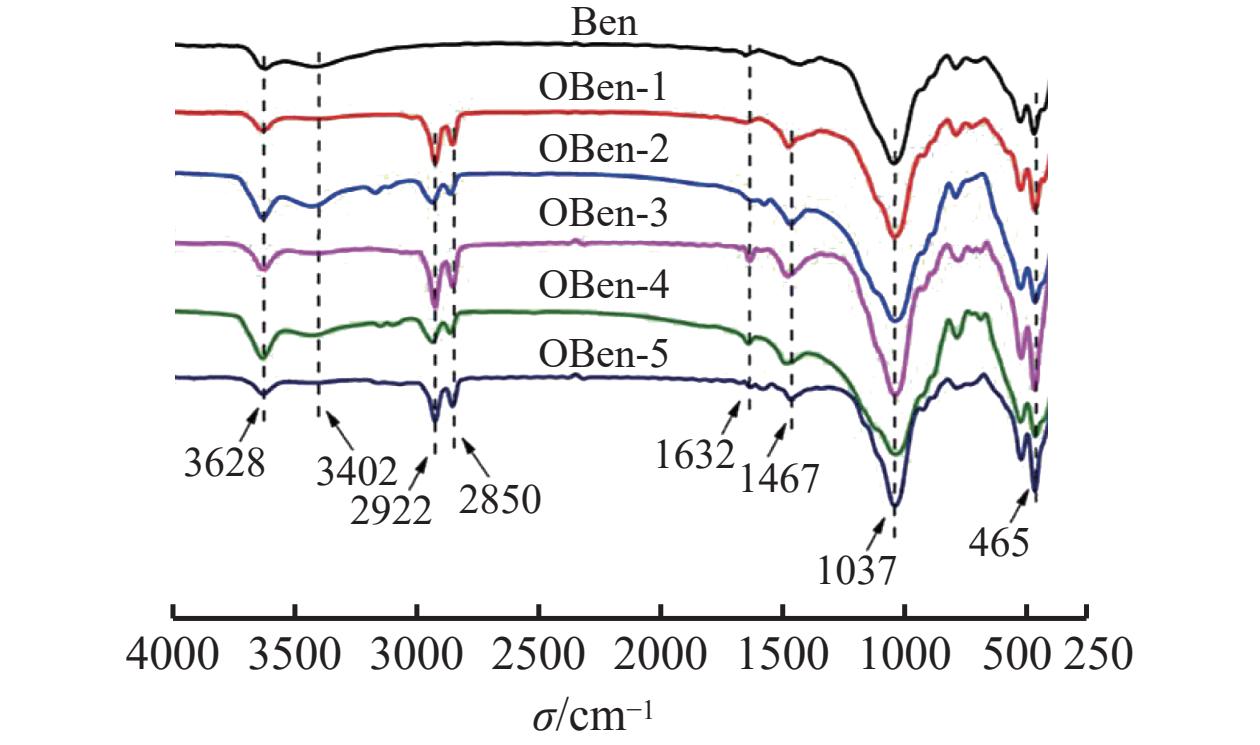
摘要: 为提升油基钻井液在高温下的流变性能,以膨润土为基质,对比探究头基结构(季铵、吡啶、咪唑)与烷基链长对有机土的微观结构和高温流变性能的影响规律。FT-IR、XRD和热重结果表明,改性剂均通过头基静电吸附/尾链疏水作用插层于膨润土层间或物理吸附于表面,CTAC、OPB、CPB、OMB与CMB通过物理吸附/静电插层在膨润土上的最大负载量分别为0.37/0.56 、0.021/0.63、0.44/0.28、0.016/0.54、0.17/0.48 mmol/g。分子动力学模拟结果表明,高温下CPB的静电能绝对值由87.42增至88.17 kcal/mol,这与高温促进CPB与膨润土间静电作用有关。流变实验结果表明,从头基结构来看,杂环改性有机土展示出较好的高温流变性能,240 ℃热滚后OBen-3的表观黏度和动切力分别可达19 mPa·s和3 Pa;从烷基链长来看,有机土的流变性能随链长增加而大幅提升。在全油基钻井液体系中,240 ℃热滚后,OBen-3的表观黏度、塑性黏度和动切力分别为90 mPa·s、85 mPa·s和5 Pa,展现出良好的配伍性与高温流变性能。同时,OBen-3高温高压滤失量仅为3.2 mL,具有良好的降滤失性能。此外,OBen-3在油包水体系中也展现出良好的高温流变性能与高温高压降滤失性能。研究表明,引入长烷基链刚性结构可增强分子间以及有机土结构间界面作用,显著提升有机土的高温流变性能,为抗高温油基钻井液用有机土开发提供思路。Abstract: To improve the rheological performance of oil-based drilling fluids at high temperatures, bentonite was used as the matrix to comparatively investigate the effects of head-group structures, including quaternary ammonium, pyridine, and imidazole groups, and alkyl chain length on the microstructure and high-temperature rheological performance of organoclays. FT-IR, XRD, and thermogravimetric analyses showed that the modifiers were intercalated into the bentonite interlayers through electrostatic adsorption of the head groups and hydrophobic interactions among the tail chains, while some were physically adsorbed onto the surface. The maximum physical adsorption/electrostatic intercalation loadings of CTAC, OPB, CPB, OMB, and CMB on bentonite were 0.37/0.56 mmol/g, 0.021/0.63 mmol/g, 0.44/0.28 mmol/g, 0.016/0.54 mmol/g, and 0.17/0.48 mmol/g, respectively. Molecular dynamics simulations indicated that the absolute value of the electrostatic energy of CPB increased from 87.42 kcal/mol to 88.17 kcal/mol under high-temperature conditions, suggesting enhanced electrostatic interactions between CPB and bentonite. Rheological experiments showed that, with respect to head-group structures, heterocyclic-group-modified organoclays exhibited better high-temperature rheological performance, with the AV and YP of OBen-3 reaching 19 mPa·s and 3 Pa, respectively, after hot rolling at 240 ℃. As the alkyl chain length increased, the rheological performance of the organoclays improved markedly. After hot rolling at 240 ℃ in the all-oil-based drilling fluid system, OBen-3 exhibited AV, PV, and YP values of 90 mPa·s, 85 mPa·s, and 5 Pa, respectively, demonstrating good compatibility and high-temperature rheological performance. Moreover, the high-temperature and high-pressure filtration loss of OBen-3 was only 3.2 mL, indicating good filtration-loss control performance. In addition, OBen-3 exhibited favorable high-temperature rheological performance and effective high-temperature and high-pressure filtration-loss control in the water-in-oil system. This study suggests that introducing rigid structures with long alkyl chains can enhance intermolecular and interfacial interactions within the organoclay structure, thus significantly improving the high-temperature rheological performance of organoclays. These findings provide insights into the development of organoclays for high-temperature-resistant oil-based drilling fluids.
-
Key words:
- Oil-based drilling fluid /
- Organoclay /
- Bentonite /
- Surfactant /
- Rheological performance
-
表 1 有机膨润土在240 ℃热滚前后的流变性和胶体率
样品 实验条件 AV/
mPa·sPV/
mPa·sYP/
Pa胶体率/
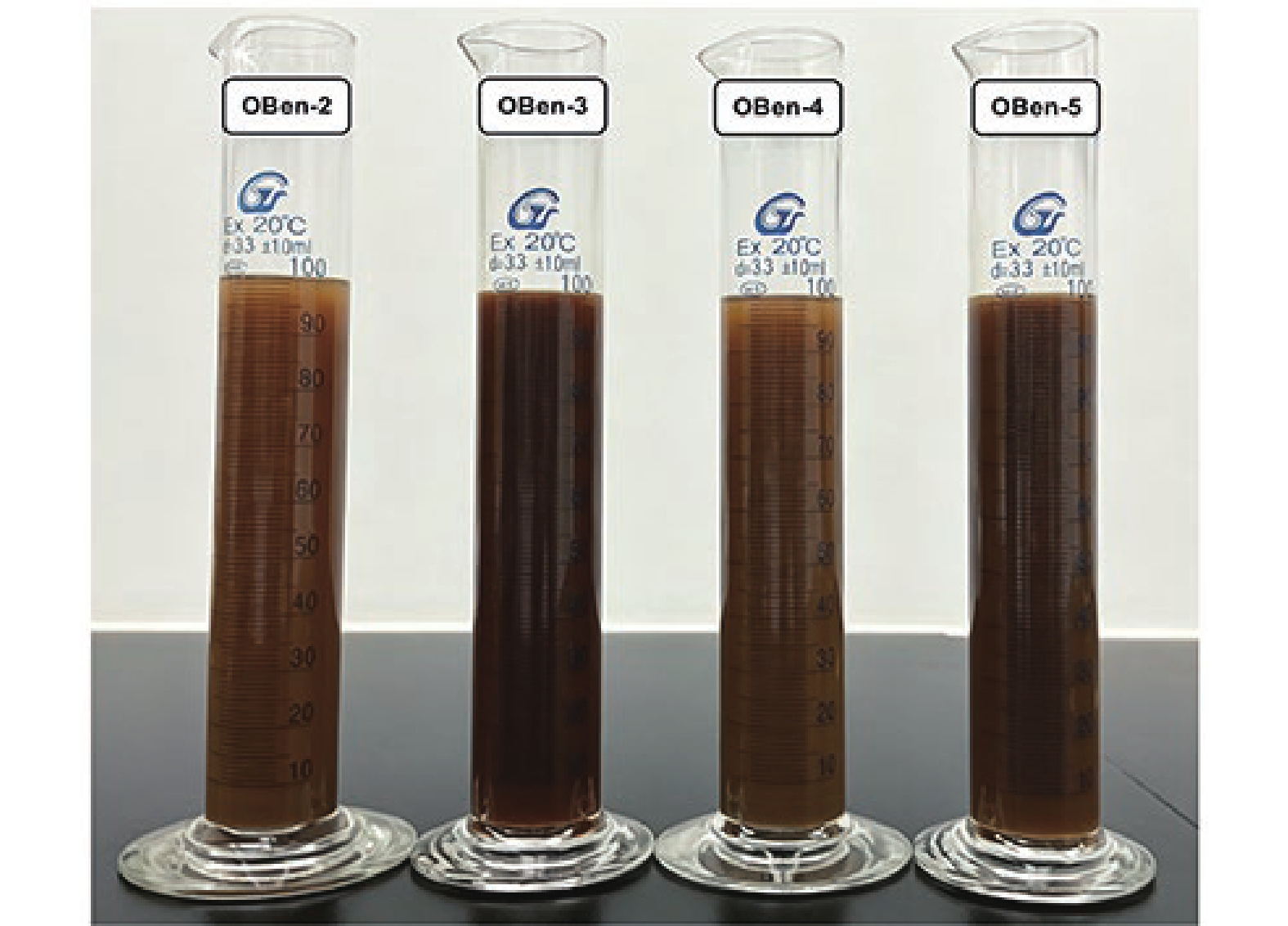
%OBen-1 热滚前 13.5 10 3.5 100 240 ℃ × 16 h 16.5 14 2.5 100 OBen-3 热滚前 11.5 9 2.5 100 240 ℃ × 16 h 19.0 16 3.0 100 OBen-5 热滚前 13.5 10 3.5 100 240 ℃ × 16 h 21.0 18 3.0 100  下载: 导出CSV
表 2 有机膨润土在240 ℃热滚前后的流变性和胶体率
样品 实验条件 AV/
mPa·sPV/
mPa·sYP/
Pa胶体率/
%OBen-2 热滚前 9.0 8.5 0.5 50 240 ℃ × 16 h 8.5 8.0 0.5 96 OBen-3 热滚前 11.5 9.0 2.5 100 240 ℃ × 16 h 19.0 16.0 3.0 100 OBen-4 热滚前 9.0 8.5 0.5 94 240 ℃ × 16 h 8.5 8.0 0.5 96 OBen-5 热滚前 13.5 10.0 3.5 100 240 ℃ × 16 h 21.0 18.0 3.0 100
下载: 导出CSV
表 3 3种全油基体系240 ℃热滚前后的流变性与降滤失性
样品 实验条件 AV/
mPa·sPV/
mPa·sYP/
PaFLHTHP/
mL2.5%OBen-1 热滚前 79.0 73 6.0 − 240 ℃×16 h 85.0 82 3.0 − 2.5%OBen-3 热滚前 81.0 73 8.0 − 240 ℃×16 h 90.0 85 5.0 3.2 2.5%OBen-5 热滚前 74.0 69 5.0 − 240 ℃×16 h 81.5 79 2.5 − 注:FLHTHP在200 ℃、3.5 MPa下测定。
下载: 导出CSV
表 4 油包水体系240 ℃热滚前后流变性能与降滤失性能
样品 实验条件 AV/
mPa·sPV/
mPa·sYP/
PaFLHTHP/
mL3%OBen-3 热滚前 41.5 35 6.5 − 240 ℃×16 h 81.5 72 9.5 5 注:FLHTHP在200 ℃、3.5 MPa下测定。
下载: 导出CSV
表 5 不同温度下改性剂与膨润土的吸附能
改性剂 T/K 吸附能/(kcal·mol−1) 总吸附能 范德华能 静电能 CPB 298 −114.86 −26.67 −87.42 513 −113.98 −25.04 −88.17
下载: 导出CSV
-
[1] Mahmoud A, Gajbhiye R, Elkatatny S. Application of organoclays in oil-based drilling fluids: A review[J]. ACS Omega, 2023, 8(33): 29847-29858. doi: 10.1021/acsomega.2c07679 [2] Minakov A V, Lysakova E I, Skorobogatova A D, et al. Experimental study of the effect of crystalline aluminum oxide nanofibers on the properties of oil-based drilling fluids[J]. Journal of Molecular Liquids, 2023, 388: 122676. doi: 10.1016/j.molliq.2023.122676 [3] 王中华. 国内钻井液技术进展评述[J]. 石油钻探技术, 2019, 47(3): 95-102. doi: 10.11911/syztjs.2019054Wang Zhonghua. Review of progress on drilling fluid technology in China[J]. Petroleum Drilling Techniques, 2019, 47(3): 95-102. doi: 10.11911/syztjs.2019054 [4] 王中华. 国内钻井液技术现状与发展建议[J]. 石油钻探技术, 2023, 51(4): 114-123.Wang Zhonghua. Current situation and development suggestions for drilling fluid technologies in China[J]. Petroleum Drilling Techniques, 2023, 51(4): 114-123. [5] 王显光, 李雄, 林永学. 页岩水平井用高性能油基钻井液研究与应用[J]. 石油钻探技术, 2013, 41(2): 17-22.Wang Xianguang, Li Xiong, Lin Yongxue. Research and application of high performance oil base drilling fluid for shale horizontal wells[J]. Petroleum Drilling Techniques, 2013, 41(2): 17-22. [6] 张明. 油基钻井液用有机土的制备及性能评价[J]. 石油化工应用, 2023, 42(4): 54-57. doi: 10.3969/j.issn.1673-5285.2023.04.010Zhang Ming. Preparation and performance evaluation of organic clay for oil-based drilling fluids[J]. Petrochemical Industry Application, 2023, 42(4): 54-57. doi: 10.3969/j.issn.1673-5285.2023.04.010 [7] 庄官政. 油基钻井液用有机黏土的制备、结构和性能研究[D]. 北京: 中国地质大学(北京), 2019.Zhuang Guanzheng. Preparation and characterization of organoclays for oil-based drilling fluids[D]. Beijing: China University of Geosciences (Beijing), 2019. [8] 王进. 蒙脱石层间结构的分子力学和分子动力学模拟研究[D]. 太原: 太原理工大学, 2005.Wang Jin. Molecular mechanics and molecular dynamics simulation studies of interlayer structure in montmorillonite[D]. Taiyuan: Taiyuan University of Technology, 2005. [9] Ding F, Gao M L, Shen T, et al. Comparative study of organo-vermiculite, organo-montmorillonite and organo-silica nanosheets functionalized by an ether-spacer-containing Gemini surfactant: Congo red adsorption and wettability[J]. Chemical Engineering Journal, 2018, 349: 388-396. doi: 10.1016/j.cej.2018.05.095 [10] Yang S S, Huang Z Y, Li C Q, et al. Individual and simultaneous adsorption of tetracycline and cadmium by dodecyl dimethyl betaine modified vermiculite[J]. Colloids and Surfaces A: Physicochemical and Engineering Aspects, 2020, 602: 125171. doi: 10.1016/j.colsurfa.2020.125171 [11] Msadok I, Hamdi N, Rodríguez M A, et al. Synthesis and characterization of Tunisian organoclay: application as viscosifier in oil drilling fluid[J]. Chemical Engineering Research and Design, 2020, 153: 427-434. doi: 10.1016/j.cherd.2019.11.010 [12] Yan X, Liu Y C, Hou Z M, et al. Cleaning oil-based drilling cuttings with synthetic Gemini surfactants[J]. ACS Omega, 2024, 9: 10488-10497. doi: 10.1021/acsomega.3c08618 [13] Ding F, Shen T, Mao S S, et al. Adsorption behavior and wettability alteration of bis-imidazolium salts on vermiculite: experimental and theoretical studies[J]. Petroleum Science, 2022, 19(5): 2460-2471. doi: 10.1016/j.petsci.2022.01.009 [14] Yang Q, Gao M L, Luo Z X, et al. Enhanced removal of bisphenol A from aqueous solution by organo-montmorillonites modified with novel Gemini pyridinium surfactants containing long alkyl chain[J]. Chemical Engineering Journal, 2016, 285: 27-38. doi: 10.1016/j.cej.2015.09.114 [15] 倪晓骁, 史赫, 程荣超, 等. 油基钻井液用改性锂皂石增黏提切剂[J]. 钻井液与完井液, 2022, 39(2): 133-138. doi: 10.12358/j.issn.1001-5620.2022.02.001Ni Xiaoxiao, Shi He, Cheng Rongchao, et al. A modified hectorite viscosifier and gelling agent for oil based drilling fluids[J]. Drilling Fluid & Completion Fluid, 2022, 39(2): 133-138. doi: 10.12358/j.issn.1001-5620.2022.02.001 [16] Ren H P, Tian S P, Zhu M, et al. Modification of montmorillonite by Gemini surfactants with different chain lengths and its adsorption behavior for methyl orange[J]. Applied Clay Science, 2018, 151: 29-36. doi: 10.1016/j.clay.2017.10.024 [17] Nong Y Y, Sun J L, Fu M, et al. Effects of cationic modifier type on the structure and morphology of organo-montmorillonite and its application properties in a high-temperature white oil system[J]. Applied Clay Science, 2021, 203: 105995. doi: 10.1016/j.clay.2021.105995 [18] Rai B, Sathish P, Tanwar J, et al. A molecular dynamics study of the interaction of oleate and dodecylammonium chloride surfactants with complex aluminosilicate minerals[J]. Journal of Colloid and Interface Science, 2011, 362(2): 510-516. doi: 10.1016/j.jcis.2011.06.069 [19] Xie G, Xiao Y R, Deng M Y, et al. Investigation on the inhibition mechanism of alkyl diammonium as montmorillonite swelling inhibitor: experimental and molecular dynamics simulations[J]. Fuel, 2020, 282: 118841. doi: 10.1016/j.fuel.2020.118841 -

 点击查看大图
图(7) / 表(5)
计量
- 文章访问数: 5
- HTML全文浏览量: 1
- PDF下载量: 0
- 被引次数: 0
