



Effects of Oil-Based and Water-Based Drilling Fluids on Fracture Propagation Pressure
-
摘要: 针对准噶尔盆地盆1井西凹陷二叠系裂缝性地层钻井过程中井漏与井壁失稳问题,为明确油基/水基钻井液对裂缝延伸压力的影响机制,开展了油基/水基钻井液对裂缝延伸压力的对比分析。结合岩石力学测试、岩石物性参数分析以及钻井液性能测试,开展了岩心裂缝延伸物理模拟实验,系统探讨了岩石自身特性与钻井液性能对裂缝扩展行为的综合作用规律。实验结论如下①通过油基钻井液与水基钻井液对裂缝岩心进行压裂观察裂缝延伸压力大小,明确在相同岩石条件下油基钻井液导致的裂缝延伸压力显著高于水基钻井液;②揭示了钻井液黏度是控制裂缝延伸压力的首要因素,其重要性超过钻井液滤失性能,高黏度钻井液阻碍缝内压力有效传递,显著提升延伸压力;③阐明了岩石渗透率是滤液形成裂缝尖端“压降带”从而促进延伸的前提条件,而油基钻井液虽具强润湿性优势,但其高黏度和极低滤失量共同作用,反而抑制了压降带形成,掩盖了润湿性潜力;④基于实验数据量化了各因素对裂缝延伸压力的相对贡献度,建立了重要性排序:钻井液黏度>岩石渗透率>滤失性能>脆性指数>润湿性>孔隙度。该研究揭示了油基与水基钻井液影响裂缝延伸压力的核心机制,明确了关键控制因素及其相对重要性,为裂缝性地层安全钻井过程中钻井液类型的科学选择及井壁稳定性控制策略的制定提供了重要的理论支撑。Abstract: Lost circulation and wellbore instability have been encountered in drilling the Permian fractured formations in the sag west to the well Pen-1 in the Junggar Basin. To understand how oil-based/water-based drilling fluids affect the propagation pressure of a fracture, a comparative analysis was conducted on the effects of oil-based/water-based drilling fluids on the propagation pressure of the fracture. Physical simulation experiments on the propagation of core fractures were conducted through rock mechanical test, analysis of rock physical parameters as well as drilling fluid property test, and the law of the integrated action of the rock properties and drilling fluid properties on the propagation of fractures was systematically investigated. The conclusions of the experiments are as follows: ① fracturing the fractured cores with oil-based and water-based drilling fluids to observe the magnitude of the propagation pressure of the fractures, and it was found that the propagation pressure of the fractures measured in tests with oil-based drilling fluids is remarkably higher than that measured in tests with water-based drilling fluids. ② It was revealed that the drilling fluid viscosity is the primary factor controlling the propagation pressure of a fracture, and its importance exceeds the filtration property of the drilling fluid. High drilling fluid viscosity hinders the effective propagation of the pressure inside the fracture, hence significantly increasing the propagation pressure. ③ It was clarified that rock permeability is the prerequisite for the drilling fluid filtrates to form a “pressure drop zone” at the tip of a fracture and hence to promote the propagation. For oil-based drilling fluids, although having strong wetting capacity, their high viscosity and extremely low filtration rate work together to suppress the formation of the “pressure drop zone”, thereby masking the wettability potential. ④ Based on the experimental results, the contribution of each factor to fracture propagation pressure is quantified, the importance of these factors is listed as this: drilling fluid viscosity > rock permeability > filtration property > brittleness index > wettability > porosity. This research reveals the core mechanisms of oil-based and water-based drilling fluids in affecting the propagation pressure of a fracture, clarifies the key control factors and their relative importance, and provides an important theoretical support to the scientific selection of drilling fluid types and the formulation of control strategy for wellbore stability in safely drilling fractured formations.
-
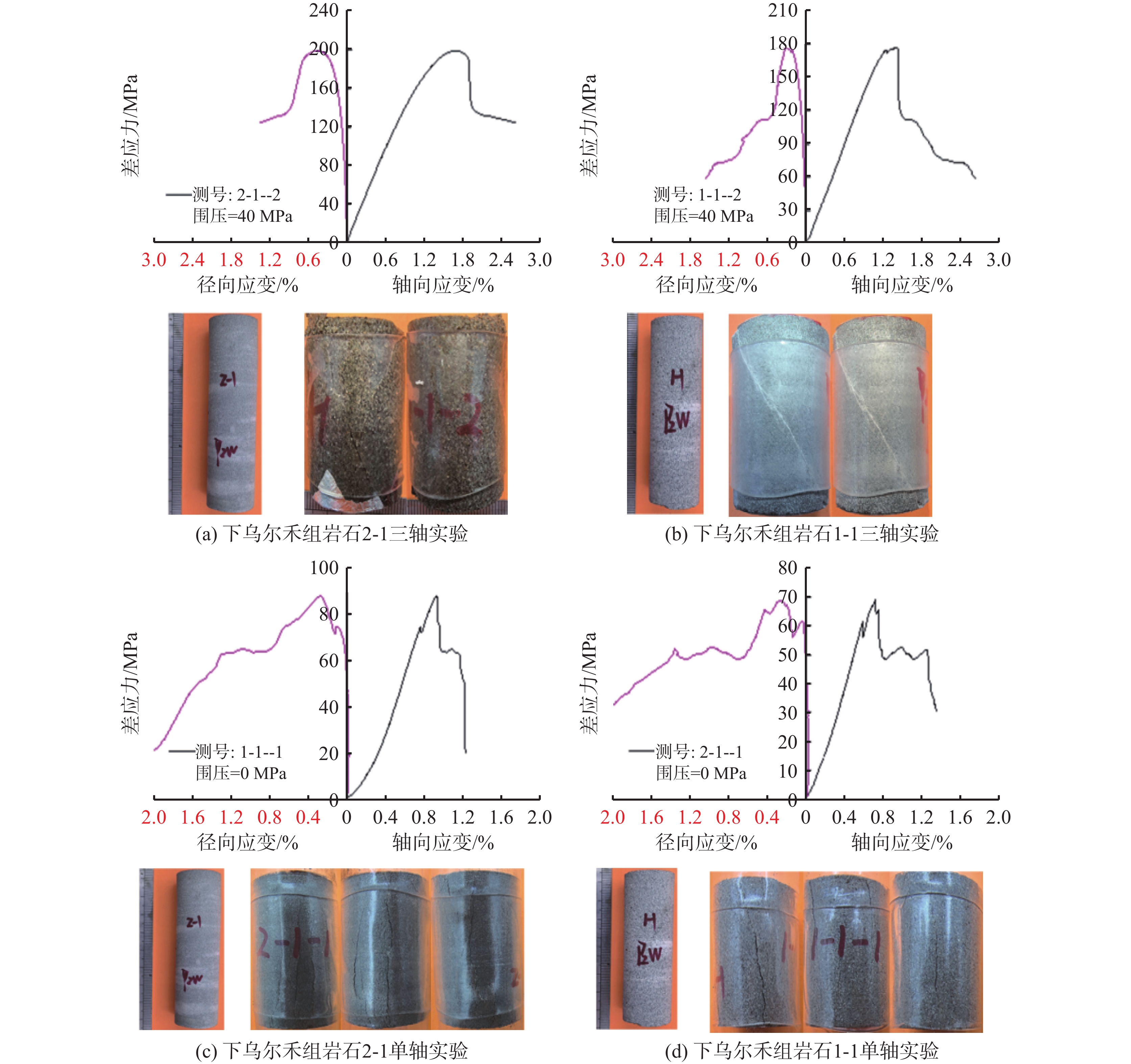
表 1 岩石三轴与单轴压缩实验力学参数对比结果
编号 岩心 围压/
MPa泊松比 弹性模量/
MPa抗压强度/
MPa内聚力/
MPa内摩擦角/
(°)1-1a 
0 0.111 12 982.6 87.8 24.45 31.78 1-1b 40.0 0.114 15 871.0 176.8 2-1a 
0 0.129 11 629.1 68.8 16.68 38.27 2-1b 40.0 0.126 15 599.6 199.0  下载: 导出CSV
表 2 水/油基钻井液流变参数
钻井液 AV/
mPa·sPV/
mPa·sYP/
PaGel/
Pa/Pa水基钻井液 17.5 12 5.62 0.26/0.77 油基钻井液 27.5 26 1.53 0.77/1.53
下载: 导出CSV
表 3 下乌尔禾组与风城组岩石的孔隙度和渗透率测试结果
岩心
编号岩心 长度/
cm直径/
cm入口压力/
MPa渗透率/
mD孔隙体积/
cm2孔隙度/
%下乌尔禾组岩石1-1 
3.920 2.456 3.16 0.00042 0.613 4.28 下乌尔禾组岩石2-1 
2.440 2.44 3.50 0.00012 / / 风城组岩石
1-1
3.726 2.446 0.45 4.94 / / 风城组岩石
1-2
2.880 2.452 0.40 4.571 0.207 1.79
下载: 导出CSV
-
[1] 何立成, 唐波. 准噶尔盆地超深井钻井技术现状与发展建议[J]. 石油钻探技术, 2022, 50(5): 1-8.HE Licheng, TANG Bo. The up to date technologies of ultra-deep well drilling in Junggar basin and suggestions for further improvements[J]. Petroleum Drilling Techniques, 2022, 50(5): 1-8. [2] 何文军, 费李莹, 阿布力米提·依明, 等. 准噶尔盆地深层油气成藏条件与勘探潜力分析[J]. 地学前缘, 2019, 26(1): 189-201.HE Wenjun, FEI Liying, ABLIMITI Yiming, et al. Accumulation conditions of deep hydrocarbon and exploration potential analysis in Junggar Basin, NW China[J]. Earth Science Frontiers, 2019, 26(1): 189-201. [3] 孙金声, 杨景斌, 白英睿, 等. 裂缝性地层桥接堵漏技术发展综述与展望[J]. 石油科学通报, 2023, 8(4): 415-431. doi: 10.3969/j.issn.2096-1693.2023.04.032SUN Jinsheng, YANG Jingbin, BAI Yingrui, et al. Review and prospect of bridging plugging technology in fractured formation[J]. Petroleum Science Bulletin, 2023, 8(4): 415-431. doi: 10.3969/j.issn.2096-1693.2023.04.032 [4] 康毅力, 田国丰, 游利军, 等. 缝面摩滑: 深部裂缝性地层钻井液漏失加剧的新机制[J]. 石油钻探技术, 2022, 50(1): 45-53.KANG Yili, TIAN Guofeng, YOU Lijun, et al. Friction & sliding on fracture surfaces: a new mechanism for increasing drilling fluid leakage in deep fractured reservoirs[J]. Petroleum Drilling Techniques, 2022, 50(1): 45-53. [5] 卢运虎, 陈勉, 安生. 页岩气井脆性页岩井壁裂缝扩展机理[J]. 石油钻探技术, 2012, 40(4): 13-16. doi: 10.3969/j.issn.1001-0890.2012.04.003LU Yunhu, CHEN Mian, AN Sheng. Brittle shale wellbore fracture propagation mechanism[J]. Petroleum Drilling Techniques, 2012, 40(4): 13-16. doi: 10.3969/j.issn.1001-0890.2012.04.003 [6] 李之军, 朱茂, 智晶子, 等. 微生物无固相钻井液体系构建及其固壁作用机理研究[J]. 煤田地质与勘探, 2023, 51(4): 187-194.LI Zhijun, ZHU Mao, ZHI Jingzi, et al. Study on construction of microbial solid-free drilling fluid system and its borehole wall enhance-ment mechanism[J]. Coal Geology & Exploration, 2023, 51(4): 187-194. [7] 雷强, 唐洪明, 张烈辉, 等. 钻井液在致密砂岩中裂缝的侵入深度模型[J]. 西南石油大学学报(自然科学版), 2018, 40(4): 97-104.LEI Qiang, TANG Hongming, ZHANG Liehui, et al. Invasion depth model for drilling fluids in fractures in dense sandstones[J]. Journal of Southwest Petroleum University(Science & Technology Edition), 2018, 40(4): 97-104. [8] 代锐, 马传华, 黄洪林, 等. 裂缝性地层呼吸效应特征实验研究[J]. 钻探工程, 2025, 52(1): 93-101. doi: 10.12143/j.ztgc.2025.01.013DAI Rui, MA Chuanhua, HUANG Honglin, et al. Experimental study on the characteristics of respiration effect in fractured formations[J]. Drilling Engineering, 2025, 52(1): 93-101. doi: 10.12143/j.ztgc.2025.01.013 [9] 潘丽燕, 郝丽华, 刘凯新, 等. 玛湖风城组高含盐储层水力压裂裂缝扩展规律[J]. 新疆石油天然气, 2023, 19(4): 20-28.PAN Liyan, HAO Lihua, LIU Kaixin, et al. Fracture propagation law of hydraulic fracturing in High-Salinity reservoir of Fengcheng formation in Mahu[J]. Xinjiang Oil & Gas, 2023, 19(4): 20-28. [10] 邵长跃, 潘鹏志, 赵德才, 等. 流量对水力压裂破裂压力和增压率的影响研究[J]. 岩土力学, 2020, 41(7): 2411-2421, 2484. doi: 10.16285/j.rsm.2019.2145SHAO Changyue, PAN Pengzhi, ZHAO Decai, et al. Effect of pumping rate on hydraulic fracturing breakdown pressure and pressurization rate[J]. Rock and Soil Mechanics, 2020, 41(7): 2411-2421,2484. doi: 10.16285/j.rsm.2019.2145 [11] 江梦雅, 王江涛, 刘龙松, 等. 准噶尔盆地盆1井西凹陷石炭系—二叠系天然气特征及成藏主控因素[J]. 岩性油气藏, 2023, 35(3): 138-151. doi: 10.12108/yxyqc.20230312JIANG Mengya, WANG Jiangtao, LIU Longsong, et al. Characteristics and main controlling factors of natural gas of Carboniferous-Permian in western well Pen-1 sag, Junggar Basin[J]. Lithologic Reservoirs, 2023, 35(3): 138-151. doi: 10.12108/yxyqc.20230312 [12] 刘之的, 汤小燕, 于红果, 等. 基于岩石力学参数评价火山岩裂缝发育程度[J]. 天然气工业, 2009, 29(11): 20-21, 26.LIU Zhide, TANG Xiaoyan, YU Hongguo, et al. Evaluation of fracture development in volcanic rocks based on rock mechanical parameters[J]. Natural Gas Industry, 2009, 29(11): 20-21,26. [13] STARFIELD A M, CUNDALL P A. Towards a methodology for rock mechanics modelling[J]. International Journal of Rock Mechanics and Mining Sciences & Geomechanics Abstracts, 1988, 25(3): 99-106. [14] 延新杰, 李连崇, 张潦源, 等. 岩石脆性对水力压裂裂缝影响的数值模拟实验[J]. 油气地质与采收率, 2017, 24(3): 116-121.YAN Xinjie, LI Lianchong, ZHANG Liaoyuan, et al. Numerical simulation experiment of the effect of rock brittleness on fracture propagation of hydraulic fracturing[J]. Petroleum Geology and Recovery Efficiency, 2017, 24(3): 116-121. [15] 李邵军, 匡智浩, 邱士利, 等. 岩石脆性评价方法研究进展及适应性探讨[J]. 工程地质学报, 2022, 30(1): 59-70.LI Shaojun, KUANG Zhihao, QIU Shili, et al. Review of rock brittleness evaluation methods and discus-sion on their adaptabilities[J]. Journal of Engineering Geology, 2022, 30(1): 59-70. [16] RAMSAY J G. Folding and fracturing of rocks[M]. New York: McGraw-Hill, 1967. [17] HUCKA V, DAS B. Brittleness determination of rocks by different methods[J]. International Journal of Rock Mechanics and Mining Sciences & Geomechanics Abstracts, 1974, 11(10): 389-392. [18] TARASOV B, POTVIN Y. Universal criteria for rock brittleness estimation under triaxial compression[J]. International Journal of Rock Mechanics and Mining Sciences, 2013, 59: 57-69. doi: 10.1016/j.ijrmms.2012.12.011 [19] 李庆辉, 陈勉, 金衍, 等. 页岩脆性的室内评价方法及改进[J]. 岩石力学与工程学报, 2012, 31(8): 1680-1685.LI Qinghui, CHEN Mian, JIN Yan, et al. Indoor evaluation method for shale brittleness and improvement[J]. Chinese Journal of Rock Mechanics and Engineering, 2012, 31(8): 1680-1685. [20] RICKMAN R, MULLEN M, PETRE E, et al. A practical use of shale petrophysics for stimulation design optimization: all shale plays are not clones of the barnett shale[C]//Paper presented at the SPE Annual Technical Conference and Exhibition. Denver, Colorado, 2008: SPE-115258-MS. [21] SUN S Z, WANG K N, YANG P, et al. Integrated prediction of shale oil reservoir using Pre-Stack algorithms for brittleness and fracture detection[C]//Paper presented at the International Petroleum Technology Conference. Beijing, 2013: IPTC-17048-MS. [22] 侯冰, 刘庆, 耿智, 等. 裂缝性致密油藏地质-工程一体化开发[J]. 新疆石油地质, 2018, 39(4): 480-484.HOU Bing, LIU Qing, GENG Zhi, et al. Integrated Geology-Engineering development technology for fractured tight oil reservoirs[J]. Xinjiang Petroleum Geology, 2018, 39(4): 480-484. -

 点击查看大图
图(6) / 表(3)
计量
- 文章访问数: 14
- HTML全文浏览量: 7
- PDF下载量: 3
- 被引次数: 0
